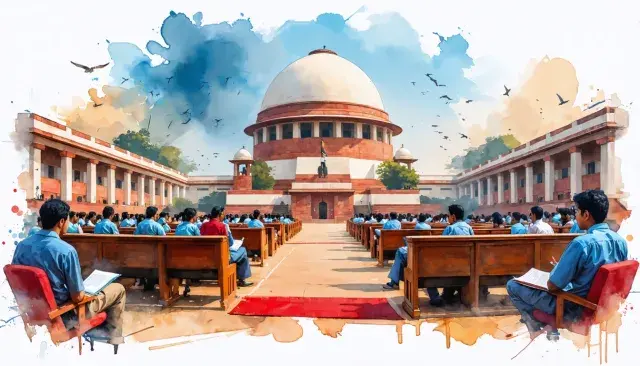

The Supreme Court of India will examine pleas contesting the sharp drop in qualifying cut-off percentiles for the NEET-PG 2025-26 examination on April 28. This development arises from a public interest litigation that labels the move arbitrary and a threat to patient safety, even as the government defends it as essential to fill thousands of vacant postgraduate medical seats. At stake lies the balance between bolstering healthcare infrastructure and upholding rigorous entry standards for future specialists.
Petitioners Question Necessity and Risks
Senior advocate Gopal Sankaranarayanan argued for the petitioners that enough candidates already qualified under prior cut-offs to occupy all available seats. He attributed persistent vacancies to high admission fees, not a shortage of eligible doctors, making further reductions unnecessary. The original plea by advocate Satyam Singh Rajput goes further, calling the adjustment to zero or negative percentiles unprecedented and unconstitutional under Articles 14 and 21. It warns that admitting candidates with such low scores into postgraduate training endangers public health and erodes medical education's integrity, especially after results and two counselling rounds concluded.
Government Defends Move to Fill Seats
The Union Ministry of Health and Family Welfare countered that expert bodies deliberated extensively before lowering cut-offs, driven by substantial unfilled positions. Data shows around 70,000 postgraduate seats nationwide for 2025-26, including 31,742 under All India Quota, with 9,621 left vacant after the second counselling round and nearly 20,000 projected to remain empty. The revision, notified on January 13, added over one lakh candidates for the third round without changing relative merit, the Centre stated in affidavits. The Directorate General of Health Services emphasized this as a policy choice under the National Medical Commission Act, 2019, aimed at optimal use of healthcare resources.
Past Patterns and Procedural Notes
Such reductions echo prior years, including a drop to zero across categories in 2023, underscoring recurring challenges in postgraduate medical admissions. The National Board of Examinations in Medical Sciences clarified it merely conducts exams and publishes results per directives from bodies like the DGHS and NMC, denying any decision-making role. A bench led by Justices P.S. Narasimha and Alok Aradhe issued notices earlier to key stakeholders and deferred merits discussion. The NBEMS noted potential harm to 95,913 newly eligible candidates, citing a Delhi High Court ruling that dismissed similar safety and merit dilution fears.
Implications for Medical Education
NEET-PG serves as India's national gateway to postgraduate medical courses, screening MBBS graduates for specialized training. Vacancies strain healthcare delivery, particularly in underserved areas, yet critics fear relaxed standards could flood systems with underprepared professionals. The upcoming hearing may clarify judicial boundaries in academic policy, influencing how India addresses doctor shortages amid rising demand. Resolution will affect counselling timelines and seat allocations, with broader ripples for public trust in medical qualifications.